*spoilers abound...
The heart of most Korean drama is a love
story. To those trained on Hollywood or European cinema love, Korean romance will seem light -friendship, conversation, helping, hands touching, plucking an eyelash off a cheek, and catch on a fall does some heavy lifting. Too often there's a love triangle, among
lead and supporting characters, sometimes driving the narrative tension and, other times, only background noise.
A parallel story line is
spiraled around this love story, like a rope that leads, as expected, to
a knot. This parallel story may tackle contemporary social issues,
engage fantasy or historical Joseon-period
narratives. As with all shows, the writing, acting, and production
value are the weak or strong fibers entwined in the making of this rope,
but it is the love story that pulls us along (I know fellas, it's the
sword fights).
Yet, I am surprised how often the male leads lack personality. Cool, stoic, yes, and occasionally even tearful, but rarely interesting, rarely lively. I have watched Park Eun Bin as the love interest of a ghost, twice a coworker, a pianist, a faux-cousin/supervisor, a royal tutor, and now, in Castaway Diva, a reporter or TV producer (still in ♥ ▵). Although these male lead roles trend toward stiff, personality-less characters, they do support the lead woman's ambitions and remain "by her side." As in our own culture, overcoming generations of patriarchy and gender roles is represented and, one may reasonably guess, valued by the presumed demographic for these shows.
Fortunately for 연모, aka Yeonmo (Revised Romanization) or, as on Netflix - The King's Affection, the male lead, Ji-un, was animated, smiled frequently, showed confusion, solemnity, doubt. Given the restrained portrayal of a woman concealed as the male Crown Prince, the romantic narrative would have suffered without Rowoon's, aka Kim Seok-woo, lively royal tutor. This reversal carries the show through several mid-series episodes, until, at last, the Crown Prince is revealed to Ji-un as the woman she is. Unwavering, the two navigate the challenges of concealing her identity and Ji-un's love for the Crown Prince.
That she is also Ji-un's childhood first love -the princess cum maid-servant Da-mi, becomes largely irrelevant, and is passed off with a shrug in a later episode. I presume this plot line is necessary primarily because fate is always present among lead lovers in Korean dramas. The King's Affection appears to use fated love to drive the narrative -how else to explain such circumstances? But then, how can a woman Crown Prince sire off-spring with the unknowing Crown Princess? Fate, here, appears to lead toward tragedy, as in the scene below, where they cannot be together, or worse -that one, or both, will be executed for the treason of concealing the true identity of the Crown Prince.
The Crown Prince Lee Hwi and Royal Tutor Jung Ji-Un approach each other. He bows.
Prince
Lee Hwi: "I was wondering why you did not come by today. You did not
deliver the royal reports. Do you have any idea how worried I was?
Tutor Jung Ji-Un:" I have something I have to tell you, Your Majesty. [pause] I am going to get married."
"Why,
though? If it's because of the rumors going around; don't go through
with it. We knew this was going to be difficult and ‒"
"This is the choice I have made."
"Then..if that's what you really want, how can you just lie to me like that? Why
on earth are you going through with this? Please just tell me, why all
of a sudden you have a complete change of heart? We've been able to stay
strong through so much until right now. [pause] So, why? Is there a reason, then, why you cannot just tell me?"
"I do not want to lose you, Your Majesty. And this is the only way I can make sure that happens."
"So what are you saying, then? If you don't wish to lose me, why ‒"
"This is... [pause] I think this is where I should say goodbye, Majesty.
He bows and begins to walk away.
"Stop! Don't you dare leave!"
He stops.
"I did not say... [pause] that we were finished here. You can't leave."
Clenching his fist, he begins to walk away.
"Stop, now!" Music begins to play. "I order you!"
Holding back his emotions, "Forgive me... [pause] Your Majesty"
 |
The scene ends with the Crown Prince, isolated, alone -as in the beginning.
|
If
her use of Royal authority in a pitiful attempt to command him to stay
by her side does not tug at you -perhaps you've no heart. Of course Prince
Hwi isn't aware that Ji-un is loyal, acting only to save her life. Despite this well-worn, soap contrivance, the low-key lighting punctuated by cyan and orange, dewy eyes, and shallow depth of field beautifully package this culmination of twenty hours of
nearly-suspended disbelief in two characters who have walked
together and now cannot. Fate, it seems, is coming to its own conclusion.
Although the show is framed, largely, by royal palace courtyards and royal quarters, and sometimes landscapes or
villages, it never feels suffocated by them. The cinematic wide-screen format, variety of compositional devices from perspective
lines to boxing in, and closeups punctuated by catch lights and shallow depth of field provide room to breath; separating the feeling of The King's Affection from a swath of overly sharp, 4K productions. The wide screen format also offers an abundance of space to be filled with period details -stone walls, flowering trees, architecture, and
even sharply differentiated topography. Color is grounded in muted tones
punctuated by intense cyans, magentas, reds or white. The dark of night is produced with an eye for limited sight under low
light instead of artificially brightened scenes (see above photos).
This
visual appeal is met by Park Eun Bin's effort to inhabit
the character as wholly as she did Woo Young Woo.
Few of the actor's expressive mannerisms, often visible in her other work,
including Extraordinary Attorney Woo, were seen in The King's Affection. In portraying a girl surviving as a boy, she chose restraint rather than masquerade, and as the episodes progress, stoicism becomes displaced by an un-constructed, un-gendered entity. As their relationship grows more comfortable, the repartee between the Crown Prince and tutor Ji-un is smile inducing. One episode is memorable for a scene in which the petite
Crown Prince Hwi physically assaults a visiting, and intolerable,
eunuch. One can hardly believe that Da-mi is playing the role, self-consciously, of a young man, but is motivated by something beyond gender -a rage fired up by unjust circumstances.
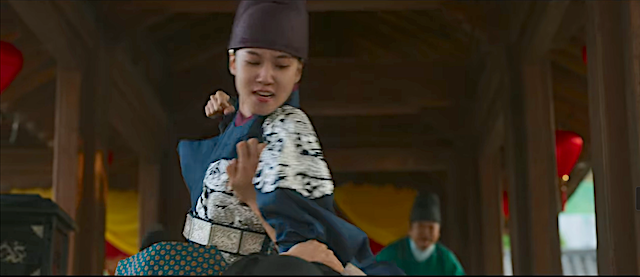
Moments like these run interference against the kit of scenes all too
commonly drawn upon in Korean drama: romantic leads bantering about jealousy, fall and
catch scenes, or unexpected rainfall met by a kind umbrella. It also adds a touch of humanity to the character, Da-mi, whose complexity is generated only by the concealment of her identity, not by any flaws such a life may have realized. When Da-mi/Crown Prince Hwi makes a poor choice, she knows it, owns it, and is
forgiven by an audience that already understands that she is not truly
at fault. Such writing caricatures good and bad behavior to a point beyond question. This becomes an oppressive construct that, in its modelling of ideal
behavior, is rather conservative. Of course, none of this is restricted to Korean dramas, but is noticeably absent in several contemporary U.S.
productions like You, Breaking Bad, Ozark, The Sopranos
and more.
The peasant or noble-born peasant with a heart of gold is a narrative trope common to Park Eun Bin's characters, whether in The King's Affection,
Father I Will Take Care of You, Ghost Detective, Judge Vs Judge, and now, Castaway Diva. To be fair, The King's Affection manages to succeed despite this limitation
-the Crown Prince, after all, was born a princess to be killed at birth, and
purportedly so, but for the grief of a mother that whisked her
unnamed daughter away in defiance of the King. Where the humble orphan meets her royal origin, there is nothing so kingly as kindness and truth. Where kindness and truth face ambition, we find sacrifice and tragedy.
 |
| The tearful, desperate end. |
For a show which, from the very beginning, moves toward tragedy, I thought it would have finished more memorably if it had only
followed its tragic logic to the end. Wouldn't a fitting, trope-bucking end sacrifice the twin sister of the real, but dead, Crown Prince Hwi to save
the kingdom by perishing alongside her familial adversary? Early on, we were primed for the deadliness of
this poison as the Crown Prince's father, the King, was also poisoned
this way by her maternal grandfather, who she now sat before, tea cup in
hand. Although the
situation was desperate, it may have been hard to
accept Crown Prince Hwi ingesting poisoned tea, if only to ensure that
her grandfather also drank it. We did not know her plan, yet we understood the stakes, the risk, and were in a position to accept her self-sacrifice.
 |
The Crown Prince after ingesting the poison
|
If the narrative had her die alongside her ruthless grandfather, all outcomes would have remained the same with one exception -this tragic love story would have remained a tragedy. The viewers may not have forgiven the writers and the writers may have struggled with modeling the hero's path toward sacrifice, but instead, they chose to take the audience to that precipice, dangle us, and then pull us, improbably, back to safety. Inevitably, we find that model characters require model endings and we are left untouched by the significance of tragedy.


