Showing posts with label birds. Show all posts

Friday, April 12, 2019

Sometimes it Snows in April


Only once in my life had I seen an April snow. I was a child, there was thunder, and in a brief but hearty spurt of winter, giant flakes accelerated toward the ground. It wasn't magical, it was eerie.

Now, living in Minnesota, I can fully connect with the metaphor written into the Prince song I listened to as a teenager in New York. Here's why...


The arrival of the robins, first week of April.


Sunday, the southerly winds introduce warm air to cold ground; fog their conversation.


It was spring. The sap told it.


Fresh mushrooms and garlic mustard told it.


The chorus frogs playing their combs told it.


So pleasant it was, combative crows and hawks sat together in harmony.


But, then, it wasn't.


Day one filled out with about eight inches of heavy, wet, snow.


Day two, today, has been wind blown snow, ice pellets tink-tink-tinking the windows, and quickly arising thunderstorms. Not as much snow as last year's three day, April blizzard, but just as disappointing.

April, sometimes.


dust from texas falls on minnesota blizzard april 2019
There was several minutes, at various points of the day, when the skies turned distinctly darker, distinctly yellow. This phenomenon, you may have seen it, can be seen when thunderstorms pass overhead, particularly in winter. So the color of the snow, in those moments, seemed a reflection of the sky, until I noticed the different coloration, blue-white, on the leeward side of snowy features -the steps, the roof fall...


dust from texas falls on minnesota blizzard april 2019
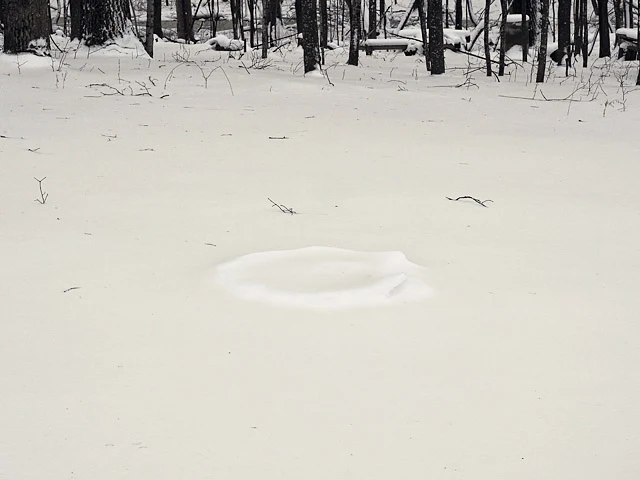
The fire ring. Like a blurred image of a moon crater taken from an earth telescope, the snow took on the contours of the rocks beneath and then sculpted, softly, by wind and shaded in relief by red-beige particles blowing northward across the land. The color was everywhere, and the limits of my imagination concocted that it was created by wind-driven ice pellets scouring the trees. But I was skeptical, this felt familiar -that I had experienced this before -so I asked the Internet.


Brown is dust from Chihuahua Desert. Click for motion Gif
Consider that the uncovered soils of the Mexico, Texas and New Mexico -in this season, their windy season (I lived in the Chihuahua Desert for three years; experienced the wind and the grit in my teeth), can be drawn all the way up to Minnesota by a powerful low pressure. What happens down there, then, also happens up here -their soils are now our soils.


Eastern Pheobe snowstorm
The Eastern Phoebe, an early spring arrival to our house and woods. We often have to chase its nest building off of doorways and gutters, and this year is no different. Our plan is to build a nesting site for this couple, but haven't quite gotten there yet. The blizzard has been a frustration for the bird, as much as us, as they mix a mud-like substance with twigs and dried grass to attach the nest to metal or wood, and these items are not available due to the new snow cover. Yet another way April can bring trouble to the arriving birds. The phoebes flew into our glass windows several times in the blizzard, looking confused, looking for a place out of the snow and wind.


Today, Friday, it continues to snow. I cannot clear the driveway as the gravel is soft from a complete defrosting, and the blower clogs immediately with the heavy, cement-like snow. I will move on to building raised beds for folks now that the wind has died down and I'm comfortable in the metal shed that sits beneath the soft-wooded, often hollow, basswood that rises 70 feet above it.


Tuesday, March 19, 2019

Osiris Rising


Winter began at the end of January. The low temperature, early Wednesday morning, January 30, bottomed at -34℉ with a high temperture of -16℉. In February, temperatures did not get very much above 10℉, and were often below zero.


My wife described these low temperatures in this way -one feels surrounded. Imagine you stepped outside of your plane on a flight across country...


When it's minus thirty you can play around with making clouds with boiling water.


I retreated to Cedar Creek Ecosystem Science Reserve one last time to work on some writing. The moon rose, and later that night, the second of several significant snowfalls began.


The snow piles higher; sliding off roofs, snow blown, and accumulation.


The icicles grow longest on the upper floors -some over six feet long.


Ice dams form where house heat melts roof snow, where the weight of snow compresses it at the edges of a roof.


By February 20th we had the snowiest February on record -with still more snow to come. By the same date, however, one begins to think of what else may come -warmth! With it comes melting, wet snows, even rain. The weight on the roof is probably okay under the cold regime, but snow is like a sponge -lighter when dry and heavier when wet. Ordinarily welcome, the warmth could become a problem.


It is easy to imagine the return of glacial lake Agassiz, forming as rainfall accumulates between a snow pack of thirty inches, four foot snow mounds, and the frozen ground. I begin to clear areas previously left untouched -in front of the greenhouse, the sidewalk between the house and front yard and six feet beyond the walkway between the house and the backyard.


I even cleared a path to the compost pile -you can almost make it out on the far right, above. This was to keep us from trudging knee deep to dump the bucket, but also to give the melt water a place to travel down slope, away from the house.


Then it was time for the inevitable: clearing the roof. Wind helped keep some edges below sixteen inches, but other spots were above eighteen inches. This view is akin to a core sample -each storm depositing more snow, compressing under the weight of the next. The upper portion is the thickest and lightest, the bottom crispy and snow-cone like.


One of my better purchases: insulated rubber boots: good to -20℉.


When climbing out a window into a thirty inch snow drift, mind the space above your head. This icicle was disturbed by my head, broke, and dropped on my noggin -not a good way to start shoveling snow off of the roof.


On March 10 we woke up to another six or seven inches of snow. This time the temperature was in the mid to high twenties and the snow sticky: aka wet snow -a sign of things to come.


A six foot tall azalea has little positive things to say about six inches of wet snow. We have noticed that between -30℉ and 30℉, the azalea leaves change form. Warmer temperatures show leaves that are open wide and flat. At colder temperatures, the leaves are tightly rolled.


By Tuesday, March 12, the air was a warm and dewy 37℉. That's when the rain started to fall. By Wednesday, we had a morning fog with near white out conditions. It continued to rain through Thursday -leading to flood reports across several Midwestern States. 

There is little moderation in the Midwestern climate -at times, we can span 70 degrees in a couple of days. On the coasts, even within a three week period, to experience below zero temperatures at the beginning and sixty degrees Fahrenheit at its end, is unheard of. With over thirty inches of snow on still frozen ground across the entire state, days of rain, and the increasing temperature to near 60℉ by Saturday, we will see large scale flooding.


Like Osiris rising from the dead, so too is spring. The geese were heard flying over just a few days ago. The birds, winter friendly, are spring noisy. The popping of basswood, Tilia americana, trunks were heard echoing among the woods on a sunny afternoon of twenty-five degrees -calling us out to tap sugar maples for sap.


From winter weather to spring in bird song.


Monday, April 9, 2018

Second Coming


On April 3 and 4 the snow fell and fell, as did the temperature, until finally it rested at 8° F and sun. What had been nearly a complete melt, the dark side of slopes and plow bergs excepted, the earth had reappeared, as did our fixings, and the mud. In a meteorologic one two, the snow came to nearly a foot, and our fixings are once again covered. In the past three years, by this time, I've already begun to shed my winter weight, pulling garlic mustard, trimming fallen trees, walking the woods, spotting emergent ephemerals, and of course, the garlic was up.


Instead, I'm watching the savanna plants tawny dereliction, and the further blueing of shadows, and the weary feet of squirrels who are at the very tops of trees tearing into buds.


After all, it was over 6 weeks ago when the winter flies came on the scene, and not long after, the flock of northerly migrating robins, as if they could smell the dipteran meal on the northwesterlies.


And here, again, they arrive. Second flush, depart and return? Maybe spring, this time.


Monday, March 12, 2018

Arrival


Possibly only once, on the morning of daylight savings, will the robins arrive to their summering grounds en masse. Sure, before, small groups of six or twelve, but not this Sunday morning, no -countless robins causing a stir among the winter locals. Crows, bluejays, black capped chickadees, and red bellied woodpecker among the fray and the crows, maybe a bit pissed off about it. Listen, more than watch, for the spring that birds bring.


Wednesday, September 13, 2017

Must

There are things you must do that you decided are a must, but no one else, or maybe someone else, but why should we care about the rules of others in matters not of their concern? A lesson graciously provided, over and over again.


 Although house work looms at the preface of autumn, the introduction to day.


Early autumn is a fantastic spectre of shortened days, shortened seasons, and shortened lives. Who decides what must be your day?


I stop to photograph the sand hill cranes whose prehistoric call so often heard, their bodies little seen. 


Walk to see small victories of woods gardening -an aster...


recovering jewelweed...


and the appearance of zig zag goldenrod along the drainage we attended to for three springs.

Now, on to applications for grants, house painting, plant planting, drainage installing, arboretum course development, and all the other allergenic musts that occupy any given day.


Saturday, July 9, 2016

The Tropic of Tanager


During our garage sale, two weeks back, we were visited for nearly 15 minutes, resting on this oak branch, insect in beak, by the Scarlet Tanager. All the way from South America, on little wings, and insect fuel. A poem.


Saturday, April 16, 2016

Findings


I'd like to tell you what kind of Oak this impressive bark belongs to, but in age, among oaks, it is a challenge without leaves. No matter, this old, large oak is anchored near a clearing made by wind of storms and pressure of fungus and disease.


On the bark of a giant that had fallen last summer, I place garlic mustard just pulled. I keep it off the soil so that it properly desiccates, a lesson learned a year ago. Now committed to the project of eradicating the weed, I think of it as gardening, a task with its own time, that I can accomplish while out photographing the woods, searching for mushrooms or ramps, or completing some other woodland project. Away from fallen logs or large stones, I make piles so the mustard remains obvious to me later, as I check on its desiccation or dispose of it. Officially known as Garlic Mustard, Alliaria petiolata, I've pulled enough acreage of it now to refer to it as "skunk mustard," because its garlic-onion odor reminds me more of that mammal's funk. Click here for a concise and useful journal article on all things problematic with garlic mustard in North America.


This upland spot was (still is?) an oak and sedge stronghold for quite some time. Now cleared of its main shade oak, what may grow in these changed conditions? Its slopes are partially covered with Pennsylvania Sedge, Carex pensylvanica, and some Virginia Waterleaf, Hydrophyllum virginianum. I found these native strawberries, Fragaria virginiana growing in patches, too. A straight line trail runs through this location, with plenty of soil disturbance from quadrupedal hooves and nosing through leaves and soil for food. Maybe I could intervene beyond pulling weeds by giving some complementary plant a foothold. We tend to avoid plants consumed by deer and in this way we consume them by exclusion.


While pulling skunk mustard I stumbled upon this snake, a common Eastern GarterThamnophis sirtalis. Its reaction to my sudden presence was no reaction at all.


As I continued to hover, pushing my fingers into the dried leaves to pinch-grab below the prostrate brassica stems, concern took over. I let it be, moving on around a tree to grab more mustard.


Then I spotted two more, one with coloration slightly dull compared to the other, sunning themselves near their burrow. My leaf rustling was too much antagonism and the one to the right took off. Minnesota isn't known for its snakes, although I am happy to see them here in our woods. Along with our frogs and salamanders, they are an important indicator of the land's well-being.


It's been very dry so far this spring (and despite constant snow cover, the winter was short on snow). In our new climate reality, we anticipate extended dry periods along with excessive rains from thunderstorms. Because of the lack of runoff from non existant spring rains, I was able to navigate the entire small wetland, plodding across acres of dried, sun-bleached naples yellow grasses. I witnessed the garlic mustard making inroads into the wetland as well as an arm or two of Creeping Charlie, Glechoma hederacea. I also spotted considerable patches of Stinging Nettle, Urtica dioica growing among the garlic mustard, but also several feet farther into the wetland. There is a tree, likely an ash, rooted at the edge of the wetland but fallen into it that has continued to send up branches along its trunk. Under the tree's crown there is a muddy circle where only the plants, above, are growing. At first glance I thought "Marsh Marigold?" Maybe not. Thoughts?

I did make a soggy-footed attempt into the great wetland on the south side. I wanted to see the willows -the first pale greening of spring, up close, but I didn't make it far enough in to be truly rewarded. Underneath those grasses were channels and ponds of water still draining from a much larger supply of slopes than the little wetland to the north. I did see evidence of Swamp Milkweed, Asclepias incarnata, about twenty five feet from the wood's edge. The exploration of the wetlands, our sunny places, compels me to engineer a boardwalk (literally -cut logs, debarked and placed longitudinally, with boards run lengthwise between them). Future projects.


Closer to the house, on the dry slopes bloom Bloodroot, Sanguinaria canadensis. Maybe these can be planted in the clearing among the wild strawberries?


There have been many sightings of hawks, vultures, eagles, sandhill cranes, turkeys of course, and others to make seeing the more common birds seem, well, common. Yet the first robin of spring was worth pausing for, as well as bluejays and cardinals hanging together.


And while squirrels aren't on anyone's favorites list, they have yet to cause us any trouble, likely because their habitat is still largely intact. They do not come toward the house and didn't mess with last year's garden. This bounding fellow has a red head, feet, and tail. I wonder if it this one, from last fall, or a relative.


Saturday, February 13, 2016

The Eagle Has Landed

While working on a proposal for Franconia Sculpture Park, I heard a continuous calling just outside the attic windows that, to my mind, sounded like seagulls but I knew that couldn't be right. No, the high pitched call was an eagle being harassed by red tail hawks.


I do not know much about large raptors, nor specifically Bald Eagles. There were several sightings over the last four months and Betsy said there were three others at the time I photographed this one. Are they passing through, southward or northward? Do they come for an easy meal on the edge of the woods, wetlands, or lawn?


The woods has resident Red Tail Hawks -I see them scanning the edges regularly. Although I've witnessed the bald eagle and red tail hawk calmly, quietly circling together last autumn, I now see that these two raptors do not always get along.


The eagle extended its wings and squealed whenever the hawk engaged in a harassing fly over. Another hawk perched in a neighboring tree.


After forty five minutes or so, baldy finally gives in to the harassment of the hawks and moves on.


We support the red tail hawks and the regular, necessary work that they do. Yet, because bald eagles were rare in the regions of my life, I'm glad to see them here. It adds yet another level of ecological complexity to our place at the edge of the old, Big Woods.


*You can click on the pictures for much larger images.